TANKS & PUMPING SYSTEMS
(Ranger Hope © 2008, contains edits of material courtesy of A.N.T.A. publications.)
Tanks Arrangement
Tanks perform two important tasks on a vessel. In addition to storing liquids, they provide a second skin to the vessel when located in the bottom or sides. Hence, they provide a very important watertight barrier against flooding.
Figure 3.1 shows a typical tank arrangement in a 24 metre vessel. Each of the tanks has a specific purpose and are either interconnected or kept separate from each other by a pumping system.

Figure 3.1 Tank Arrangement
Fuel System
In vessels of less than 24 metres length, fuel may be stored in a number of tanks which may either form part of the hull or be free standing as shown in figure 3.2. Note: that figure 3.2 depicts all the fittings that a tank can have, but not all tanks are thus fitted. e.g. double bottom tanks don’t have a saveall.
Tank Components
1, 16, & 17 Tank Venting
All fuel tanks are required to be vented to atmosphere (not into the vessel). The vent or breather will terminate in a gooseneck or similar arrangement, which prevents water from entering the tank down the vent. If the vent pipe is greater than 18 mm in diameter, the outlet will be fitted with a wire gauze screen or 'flame trap'.
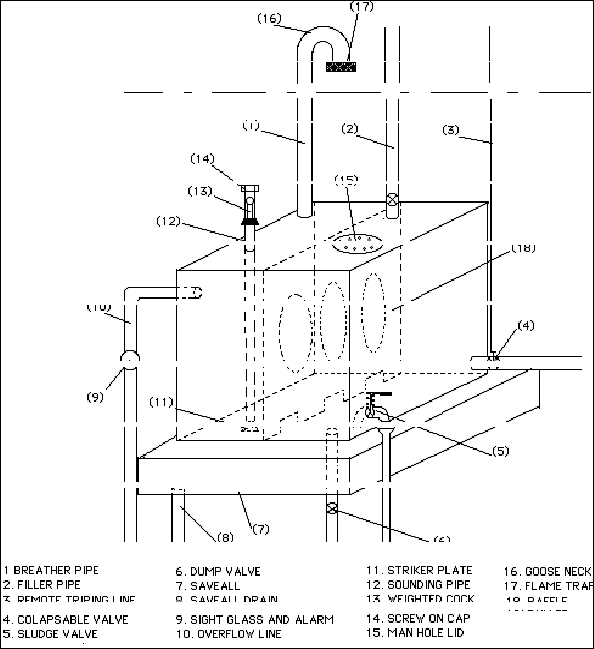
Figure 3.2 Tank Components
2. Filler Pipes
These are arranged so that any spillage will not enter the vessel. Therefore, the inlet or delivery end of the filler pipe is located outside the vessel and will have a valve and/or a water tight cap/blank. The pipe between the deck and the top of the tank may be flexible if necessary, but must be of reinforced synthetic type secured with corrosion resistant clips at each end. Note:- When transferring or re-fueling, all precautions must be observed to prevent fire or spillage. This will comprise of all fire, pollution and spill control devices being ready. However, the best way to prevent these from happening is to ensure that the personnel involved are competent with the operation, procedures and safe working practices.
3. & 4. Tripping Line and Delivery valve or cock
All fuel tanks with discharges above the bottom plates have shut off valves or cocks fitted as close as possible to each tank (preferably on the tank). These can be operated from a position outside the engine room, via a non-flammable connection, such as a steel wire
5. Sludge valve
It is necessary to remove contaminants, notably water, prior to the fuel being delivered to the engine. Therefore, fuel tanks are fitted with sludge valves, which are self closing. If this type of arrangement is not fitted, the sludge and water may be drained through the drain valve or plug.
6. Dump - Drain Valve or Plug
In the event of the tank rupturing or for inspection purposes, all fuel tanks which are not double bottoms must be fitted with a method of draining them into another storage tank (not the bilge).
7. & 8. Saveall and Drain
Because free standing tanks may be fitted 'high' in the engine room, it is necessary to have drip trays fitted to them so as to prevent any leakages onto machinery below. These savealls will also need to be drained, with the drain pipe leading to a drain tank.
9. & 10. Overflow Sight Glass & Alarm
When filling or transferring fuel there is always a danger that there may be a spillage. Due to pollution and fire hazards associated with fuel oil, it is usual for tanks to be fitted with an overflow pipe which leads to either an overflow tank or to a double bottom fuel tank. These overflows are also fitted with a sight glass and audible alarm.
11. 12. 13 & 14. Sounding Pipe, Striker Plate, Weighted Cock & Screw on Cap
Some method of measuring the contents of the tanks is fitted to the tank. This can either be a dial gauge or sight glass. However, most tanks will be fitted with some method by which the contents can be measured or sounded by a sounding tape or dip stick. The sounding pipe will extend from the top of the tank to near the bottom and, fitted with a screw on cap-plug, and may have a self closing cock. At the bottom of the sounding pipe a striker plate is welded to the tank. to prevent a hole being 'punched' in the tank by the measuring device.
15. Manhole
For tanks which have a capacity of more than 800 litres, a manhole or hand hole for cleaning and inspection purposes will be provided either on the top or on the sides of the tank. Areas such as the top or bottom of tank where water and condensation will accumulate, are prone to corrosion. These areas will need a close inspection. The bottom of the sounding pipe is another important area since if this corrodes out the sounding device may become 'jammed' in the pipe.
If the tank is fitted with a sight glass, this must have self closing cocks at the top and bottom. Under no circumstances must these cocks be wired open - as they will prevent a spill should the glass break.
18. Baffles
Baffles spaced not more than 1 m apart are fitted to reduce the free surface effect.
Typical Layout
Figure 3.3 shows a vessel fitted with four main fuel oil storage tanks and one day tank for the main engine. As can be seen the fuel can be put into the storage tanks from the filling line on deck and transferred between tanks by the use of the fuel oil transfer pump(s). The transfer pump also delivers fuel to the daily service tank, which in turn delivers fuel to the engine. Some vessels may have two day tanks, thus the fuel return from the engines injectors should be changed over when the delivery is changed.

Figure 3.3 Fuel Oil System
Fuelling Precautions
Understand and comply with all port regulations.
Ensure that all personnel involved with the operation, understand the systems and procedures for refuelling.
Moor the vessel securely.
Keep fire-fighting appliances in readiness.
Keep clean up equipment ready.
Plug scuppers on deck.
Extinguish open flames or cigarettes near fuelling operation.
Ensure tank vents are clear.
Fuel lines should be secured to prevent movement.
Pipe bends should be smooth and padded where they pass over sharp edges.
If necessary ensure that lines are earthed.
Ensure that incoming fuel is clean
Pipe joints should not leak.
Maintain a constant watch to monitor flow and prevent spills.
Close filler caps after fuelling.
Clean any spills on deck.
Fresh Water System
As with fuel, fresh water may be stored in any tank aboard the vessel. However, each of these liquids must only be stored in a tank designated for that purpose. This means that it should not be possible to pump fuel into fresh water or ballast tanks and vice versa. Furthermore, these tanks should be separated from each other by a cofferdam so that if there is a leak from a fuel or ballast tank, it does not contaminate the fresh water.
Fresh water storage tanks were traditionally coated internally with a cement wash. in order to protect the tank from corrosion and maintain the quality of water However, these days proprietary branded coatings are available to do the same job effectively. The protective coating on the inside of these tanks should be inspected and repaired or renewed at regular intervals.
Since the water quality may deteriorate over time it is also common practice for the fresh water used for human consumption to be thoroughly filtered and chemically treated with a small measured amount of chlorine to kill any bacteria. In some cases a UV steriliser is used.
To prevent the fresh water pump from starting and stopping every time a tap is used, fresh water systems usually incorporate a pressure tank or “nu-press” system. This tank has a buffer of compressed air, which allows water to be supplied under pressure, with the pump operating periodically to replenish the tank.
Ballast Water System
Each ballast tank is provided with means of filling, venting, sounding and emptying. Tanks may be filled by pumping or gravitating seawater into the tank. The latter is achieved by opening the sea inlet valves and lines to the tank and by-passing the pump, so that the water fills the tank by gravity.
In figure 3.4, No 1 is the sea water inlet valve. This fitting will need to be inspected/repaired when the vessel is on the slip. Outboard of this valve or cock will be a grating which prevents some of the larger solids from entering the system. On the inboard side of the valve will be a strainer (No 2), which 'filters' out the finer solids protecting the system from blockage and damage. The inboard strainer will need to be cleaned on a regular basis, thus the isolating valve (No 3). When the strainer is being cleaned care needs to be taken to ensure that the filter screen is clean and undamaged and the sealing surfaces and jointing material is in good condition. The sea water connection to the ballast system may be connected so the water can either be gravity fed or pumped into the system.
The pump (No 4) is usually an electrically driven centrifugal type. The discharge from the pump is connected to the ballast main, which is a pipe common to all of the ballast tanks. In the drawing the ballast tanks are the fore and aft peaks (Nos 10 & 13) and the double bottoms (Nos 8,9 11, & 12).
To empty the tanks the appropriate tank, pump and overboard discharge valves are opened. It is not advisable to run any pump dry, therefore it is common practice, especially at the latter stages, to have the sea water inlet slightly opened to act as a lubricant and coolant, to the pump and to provide continuous priming.

Figure 3.4 Ballast System
Bilge System
The purpose of a bilge system is to remove unwanted water and other liquids from within the vessel. Bilge level alarms are fitted to many bilges, in particular the engine room bilges. The audible alarm must have a power supply from both mains and emergency systems and the alarm must be clearly audible to a person at the steering position under all operating conditions.
Requirements
Other than in vessels less than 7.5 metres in length, all vessels must have two bilge pumps, which in vessels of up to 20 metres may be a combination of both power and hand driven. Beyond 20 metres both pumps must be power driven and have different sources of power. Each of these pumps will have a specified discharge capacity. A further requirement is that power driven pumps must be self priming or be provided with a suitable priming device.
All bilge suctions are required to be fitted with strum, strainer or mud boxes to prevent solids from entering and either blocking or damaging the system.
Back Flooding
Back Flooding, where sea water from the sea suction floods back through the system into a bilge space or water from one bilge space floods through the system into another, is not a desirable situation and may lead to the sinking of the vessel. Back Flooding must be prevented at all times and done automatically. This is achieved with the use of non return valves in each of the bilge pipes which prevent flow back into the compartments.
Typical Arrangement
Figure 3.5 shows a bilge system as fitted on a vessel of 20 to 25 metres in length. The system looks similar to the ballast system except that the valves are mainly screw down non return as opposed to screw lift. The sea water connection (No 4) acts as a primer for the pump and is used to flush the system after pumping bilges. The forward bilge suction is not into the fore peak but into the chain locker, whereas the aft suction is from the steering flat. Each suction is fitted with a strum box (No 2) and a non return valve (No 3). No 1 is a connection to the deck or it may lead to an oil - water separator and slop tank. If the vessel is not fitted with a separate oily waste tank, the oily bilges should be pumped into a large drum or container on deck for disposal ashore at a later stage.

Figure 3.5 Bilge System
Common Problems
Mechanical Failure of Pump
Pump not turning - check power source switch is on and cable etc in good repair.
If the pump is driven from an engine it is possible that the clutch is slipping or not engaging properly.
Flexible impeller pumps shed their vanes either through old age or having been run dry. If this is the case then the impeller will need to be replaced according to manufacturers instructions.
Air Leaks
This is a common problem on the suction side of the system and may be caused by:
leaking glands on pump drive shafts
leaking glands on valves or cocks
holes in the pipework caused by mechanical damage or corrosion
compartment valves being opened or leaking thereby drawing air into the system
Blocked Bilges
Strum boxes and strainers are provided to prevent foreign material such as rags and other waste from entering the system. However, a blocked strum box in a flooded compartment may be difficult to get at to clear hence, keep the bilges clean at all times. High level bilges can lead to dangerous situations including:
Free surface effect on stability
Fire hazard due to oil in the bilges
Dangerous and explosive gases from bilges
Slippery and dangerous surfaces to work on
Corrosion
Oil and water getting on machinery situated lower down
Effect on trim, heel and draft of the ship
Cleanliness
Impaired visibility of lower spaces covered by bilges
Pollution Prevention
Oily bilges must only be discharged into a proper mobile or shore based facility. It is an offence under State and Commonwealth law to pump oil into the water.
Vessels over 400 Gross Tonnage are allowed to discharge oily bilges into the sea if certain strict conditions are met. To comply with these conditions, vessels must be fitted with oily water discharge monitoring equipment, oily water separators and sludge holding tanks. Penalties for breach of pollution regulations are very high.
Survey Requirements
The Standards specify, for vessel less than 35 metres in length, pumping systems are to be surveyed as follows:
Annual Survey: Operational test of bilge pumps, bilge alarms and bilge valves. General examination of machinery installation. Inspection of all pipe arrangements.
2 Yearly Survey: Sea injection and overboard discharge valves and cocks.
4 Yearly Survey: Tanks forming part of the hull except fuel tanks, internally.
12 Yearly Survey: Fuel tank internally.
The Australian Standards Association prescribes a colour coding scheme for the identification of pipelines. The USL Code requires that all vessels adopt this colour scheme.
The colours are as follows:
Water – Emerald Green
Steam - Silver Grey
Oil - Golden Brown
Gas - Light Beige
Acids and Alkalis - Violet
Other fluids, including drainage pipes, bilge lines, etc – Black
Fire lines - Signal Red
Air - Arctic Blue
Hazardous Services - Golden Yellow
Electricity - Light Orange
Communications - White